
善良的男人
From joint ventures to joint innovation: Why global autos look to China_我的网站

一 |

The Embassy of the Republic of Colombia in China hosted a colloquium with Héctor Abad Faciolince, a Colombian novelist, writer and journalist. The writer shared on Tuesday his growth journey from a journalist to achieve his dream as a writer, his observation of the Colombian society and his impression about the changes in China.
In a fully packed hall, Minister Plenipotentiary Jose Fernando Bermúdez Cendales said in his opening remarks that the event is part of an initiative to bring Colombian culture closer to the Chinese public while simultaneously creating new spaces for dialogue and exchange between the two countries.
Bermúdez said that Abad's visit to China offers a particularly valuable opportunity to showcase the richness of our literature and to strengthen the cultural and human bridges connecting Colombia and China.
The session, chaired by Santiago Gamboa, writer and minister counselor of the Colombian Embassy, focused on the career and body of work of Abad and in particular, El olvido que seremos (Oblivion: A Memoir).
Abad's book is a seminal work of contemporary Colombian literature in which personal and family memory engage deeply with Colombia's recent history. Its translation into Chinese allows this story to reach new readers and represents an extraordinary opportunity to bring both societies closer together through literature, per some commentators.
"We hope this gathering will be an open conversation among cultures, readers, and experiences, and a new expression of the friendship that Colombia and China continue to build," said Bermúdez.
Abad, one of the most important voices in contemporary Latin American literature, shared with the Global Times that this is his second trip in China. The last time he visited the country was two decades ago.
This time, in his eyes, China has changed a lot. In many ways, the country stands for the future of the world.
Abad said he is surprised to see how much Chinese people are depending on the electric devices and network to communicate in a virtual world, and said that he felt "like an alien."
Talking about his interaction with readers in Shanghai, Abad smiled, saying that the readers selected some phrases from his book and asked him to write down as part of the autography and signature for them.
In his book, El Olvido Que Seremos (The Oblivion We Will Be), which is acclaimed as a "love letter from a son to his father," is not only a deeply affectionate look back at familial bonds but also a courageous attempt to defy oblivion.
Rooted in true events, The Oblivion We Will Be chronicles the life of his own father. Abad noted that his father was killed in August 1987 - nearly forty years ago.
In the Western literary tradition, a father is often portrayed as a distant or even negative figure. His father, however, was "totally different - a man of love and deep sense of responsibility in both the public sphere and his family life."
Such image of a benevolent, non-authoritarian father has impressed his Chinese readers as well, he said.
As a physician, Abad's father dedicated his life to addressing fundamental issues affecting people's well-being, such as drinking water quality and public health, steadfast in the belief that the world could be made better through action.
Abad's work addresses themes such as memory, violence, inequality, and the human condition, deeply marked by the murder of his father, an event that inspired his most iconic book, The Oblivion We Will Be was published in Chinese by Writer's Publishing House in Beijing in July.
。
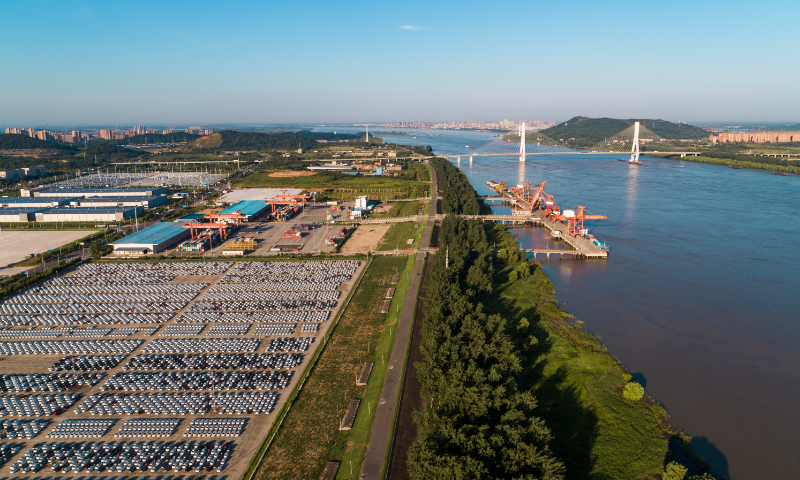
Global automakers are forging deeper and longer-term ties with China, as the country's role evolves beyond a key market into an increasingly important hub for automotive research and development (R&D) and innovation.
SAIC Motor and General Motors (GM) signed an agreement on Wednesday to extend their joint venture partnership by 20 years to 2047. A month earlier, Honda Motor and GAC Group signed a strategic agreement to renew their joint venture (JV) partnership in GAC Honda, extending their cooperation to 2038 while keeping the existing equity structure unchanged.
The renewed commitments to China by global auto giants signal more than confidence in the long-term potential of the Chinese market. It reflects China's evolving role in the global auto industry, from a manufacturing base and sales market to an increasingly important source of innovation and technologies that shapes the future of mobility, Peng Bo, a research fellow at the Chinese Academy of International Trade and Economic Cooperation under the Ministry of Commerce, told the Global Times on Sunday.
Behind this shift is the rapid rise of new-energy vehicles (NEVs) and vehicle intelligence, as global competition increasingly centers on batteries, electric powertrains, intelligent driving, automation, software ecosystems and artificial intelligence (AI), Peng said.
From market to innovation
Chinese automakers have accelerated their expansion into global markets. According to the latest data from the China Association of Automobile Manufacturers, China exported 5.096 million vehicles in the first half of the year, up 65.3 percent year-on-year, including 2.355 million NEVs, up 120 percent. In just a few decades, China's auto industry has evolved from learning from and introducing advanced foreign technologies into a major global force in automobile production, exports and innovation.
Such a picture would have been almost unimaginable several decades ago. At the time, China's auto industry was still in its early stages and lagged considerably behind global leaders.
In the 1980s, China began integrating into the global auto industry through the establishment of joint ventures. In 1984, Beijing Jeep, China's first Sino-foreign joint venture automaker, began operations, while Chinese and German partners signed the agreement for Shanghai Volkswagen. More global automakers from countries such as Germany, the US, Japan and France followed, bringing capital, technology, equipment and management expertise that helped accelerate China's auto industry development.
From annual auto production and sales of just over 1 million units in the mid-1990s, China saw the corresponding figures surpass 30 million units in 2025, ranking first globally for the 17th consecutive year. Auto exports also surged from just several thousand units to a record 7.098 million in 2025.
These figures illustrate the profound transformation of China's auto industry, which has evolved from a latecomer learning from global peers to a major manufacturing powerhouse and increasingly a source of innovation for the global auto industry, experts said.
Chinese experts attributed China's auto rise to its increasingly strong innovation capabilities. Sun Xiaohong, former secretary-general of the automotive branch of the China Chamber of Commerce for Import and Export of Machinery and Electronic Products, told the Global Times on Sunday that the close integration of R&D, manufacturing and market application has enabled new technologies to move rapidly from laboratories to mass production, while intense market competition has further accelerated innovation and product iteration.
Latest figures tell the story. China has led the world in automobile patent publications over the past decade, far ahead of the US, Japan and European countries. Patent publications in the NEV sector increased from more than 50,000 in 2016 to over 110,000 in 2025, with an annual growth rate of 17.1 percent. Intelligent connected vehicle patent publications rose from 44,000 to 93,000 over the same period, averaging annual growth of 11.6 percent.
In addition to the R&D capabilities, China's complete and highly efficient supply chain strengthens its industrial edge. The International Energy Agency estimates that battery electric car production costs are over 30 percent lower in China than in advanced economies, mainly attributed to lower battery cost and supply chain.
China's technology company Xiaomi only launched its first EV in 2024, but has quickly emerged as a major player in China's NEV market. Its strategy connects cars with smartphones, apps and smart home devices is creating a more integrated ecosystem. At Xiaomi's EV factory on the outskirts of Beijing, a new car rolls off the production line every 76 seconds on average.
Chinese automaker NIO's Hefei factory is known for its highly intelligent and automated manufacturing, using more than 700 robots and achieving an overall automation rate of 97.5 percent.
BYD's EVs can add 20 kilometers of range in just 10 seconds of charging and up to 400 kilometers in five minutes.
"These examples reflect a broader shift in China's auto industry, where strengths in advanced manufacturing, supply chains, software, AI and rapid technology commercialization are increasingly translating into a competitive edge," said Sun.
Cooperation not competition
The rapid transformation of China's auto industry has put growing pressure on some global auto giants. Honda CEO and President Toshihiro Mibe reportedly said after visiting an auto supplier factory in Shanghai, "We have no chance against this," Nikkei Asia reports.
Ola Kallenius, chairman of the board of management of Mercedes-Benz Group AG, told Chinese media that "In the world's most dynamic automotive market, you have to be here, and we're doubling down on China," People's Daily reported.
"Many major global automakers remain constrained by their long-standing reliance on traditional gasoline vehicles... Although they are pushing ahead with electrification, established technology systems, production networks and traditional development models have slowed," Jia Xinguang, an auto industry analyst, told the Global Times.
By contrast, China's auto industry has made a broad shift toward new technologies, building strengths across the industrial chain and establishing a mature and increasingly self-reliant core technology system, Jia said.
Against this backdrop, foreign automakers' approach to cooperation with China is changing.
Toyota's evolving China strategy provides a telling example. At the 2026 Beijing auto show, Toyota unveiled its "with China, for China" localization strategy, giving Chinese teams a greater role in management, R&D and product development, the Global Times learned from the Japanese company.
Toyota has expanded its China chief engineer team from four to seven, covering gasoline, hybrid and EVs across different segments. It is also empowering local management and deepening co-creation with Chinese partners to make development faster, according to the company.
A similar shift can be seen at Tesla, whose Shanghai Gigafactory is not only a major global production base, but also a key part of its global supply chain and product development. In the first half of 2026, the factory delivered nearly 468,000 vehicles, up 28.4 percent year-on-year. The Model Y L, led by Tesla's China team in design and development and manufactured in China, is also being rolled out in markets including the US, UAE, South Korea, Japan, Singapore and Australia, according to a press release that the company shared with the Global Times on Friday.
Foreign auto parts suppliers are also stepping up innovation in China. Bosch plans to invest more than 2.5 billion euros in AI development by the end of 2027, with much of its automotive-related AI work focused on China and Europe, the Xinhua News Agency reported.
Amid mounting challenges, China-foreign auto joint ventures are taking a long-term approach and actively reshaping their product strategies, R&D models and cooperation frameworks, Xinhua reported, citing Bi Wenquan, an executive vice president of FAW Toyota Motor Co.
These developments point to a broader shift: China's role for global automakers is expanding from "Made in China" to "R&D in China" and "innovation in China," making win-win cooperation increasingly important, said Sun.
For global automakers seeking to stay competitive in the next wave of industry transformation, turning competition into greater opportunities for cooperation with Chinese companies is increasingly becoming an "imperative" rather than an "option," said Sun.
As John Roth, GM senior vice president and president of GM China, said the renewed partnership "reflects the shared confidence of GM and SAIC in SAIC-GM and its long-term growth potential."
"It is not only about continuing what we have built together. More importantly, it is about building a more competitive, resilient, and sustainable business for the future," Roth said.
。
Current article:http://6ti8.cengzaodengchawonin.cyou/u0hngt/x99z.html
Published on:10:34:03
最新文章
- First regular Arctic container service China-Europe Arctic Express set to debut this week, ship operator tells GT
- 牛车水珍姐发财鱼生创办人 在家心脏病发过世
- Secession: Why some in Oregon want to become part of Idaho
- 王庆海会见软通动力集团客人
- 开展“红领巾爱祖国”系列活动
- 探索自然 感知科学
- 9部门发文激发下沉市场活力 活跃县域消费
- 俄罗斯失掉的机会
- 东南亚最强的新加坡空军,独立时连一架飞机都没有
- 上新!又一省级群众舞蹈展演活动在抚顺设置主会场
标签云
热门文章
- 大众和福特下周将宣布更深入的联盟:削减开发成本
- यूपी के इस जिले में अपराधियों की खैर नहीं! 3.96 करोड़ की लागत से बनेगा साइबर थाना, भूमि आवंटित
- 9月13日12时—16时,河北石家庄裕华区新增5例阳性感染者,轨迹公布
- Assembly polls in Himachal to be held in single phase on Nov 12. Counting to be done on Dec 8
- “红星何以照耀中国”网络国际传播活动在京启动_埃德加·斯诺_人民日报社
- 罗马诺:曼城正和尼科-奥赖利谈加薪续约,有望近期达成协议
- 삼성전자 ‘연산기 넣은 메모리’ 실증…AI 답변 속도 3배 빨라졌다
- 华硕破晓迷你主机新增“i5-13500H + 16G + 512G”版本,3999 元
- 618国补优惠没有了?国补提前结束?国家补贴政策2025最新截止时间到12月31日结束
- 益盛药业:拟使用不超过4000万元的闲置自有资金购买理财产品